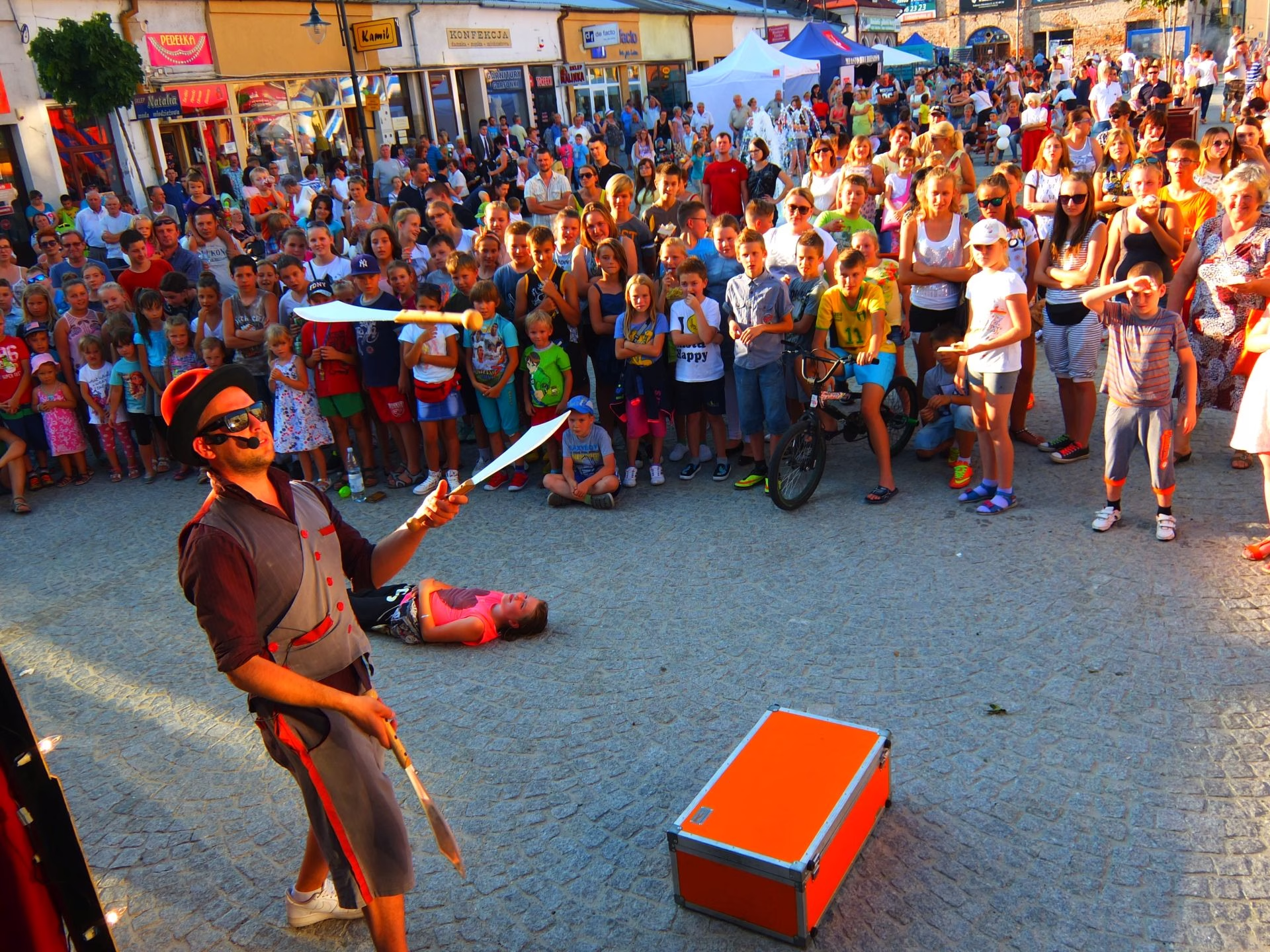
Although today it is commonly associated with not necessarily ambitious cabaret performances, pantomime has a long and noble tradition that goes back to ancient Greece! According to the definition presented in the PWN dictionary, it is “a type of theatrical performance in which the expression of the mime’s body dominates,” and, alongside psychodrama and drama, an element of theatre therapy — a concept assuming education and personality development through theatre.
From ancient Greece and Rome to commedia dell’arte
Pantomime did not originate as an independent art — it evolved from elements of dance and dramatic theatre. It flourished significantly in ancient Rome, which naturally adopted a large part of Greek culture, including the figure of the mime, who combined acrobatics, dance, and singing in short scenes. Interestingly, unlike in dramatic theatre, women were also allowed to perform in pantomime. After the fall of the Roman Empire and throughout the Middle Ages, this art almost completely disappeared, as it was not welcomed by the Catholic Church — although chronicles from that time do mention wandering performers known as ioculatores. They performed feats of dexterity, satirical scenes, and acrobatics, and this type of comedy eventually formed the basis for various folk forms of dramatic theatre. The most famous of these, still recognized today, is the commedia dell’arte, which emerged in Italy at the end of the 15th century.
Modern pantomime
It was commedia dell’arte that became the foundation for the renaissance and development of pantomime that took place in France from the mid-18th century. In these performances, gesture and facial expression dominated over spoken word, allowing the shows to be presented abroad — the form was understandable to audiences in other countries. Initially, this had a rather prosaic cause: French law forbade theatres without a license from staging performances containing spoken dialogue, and such unlicensed, often street-based theatres were extremely popular at the time. Eventually, what originally served as a loophole to bypass an unreasonable law became a catalyst for the development of pantomime as the art we know today.
Contemporary pantomime — theatre and great fun
Also in France, in the mid-19th century, the character we most associate with pantomime today was born: in the Théâtre des Funambules in Paris, the famous mime J.G. Deburau, the mute performer of Pierrot, delighted audiences with acrobatic pantomime enriched with dance. Today, pantomime is divided into two types:
- a solo mime performance in which the artist presents thoughts, phenomena, characters, and the surrounding world solely through body movement and facial expression;
- a dramaturgically developed staging featuring a group of mimes accompanied by musical, decorative, and costume design.
Pantomime, although often associated primarily with comedy, also addresses difficult, more serious themes. The fact that it eliminates verbal expression requires much greater engagement from the viewer, stimulates imagination, and prompts reflection. It is therefore a proposal not only for children but also for their parents and caregivers. Elements of pantomime can still be found today in theatre, film, circus arts, and music.